Hardware2 min read
Building a tiny working laptop
A miniature re-programmable laptop with a 128×64 OLED, custom tactile keys, and a playable Snake game squeezed into a 4KB ATtiny44.
During the quarantine in 2020, I wanted to see how small a complete, working, re-programmable laptop could get. Most miniature computer builds were using Raspberry Pis or full development boards. I wanted something pocket-sized, self-contained, and built directly from bare components.
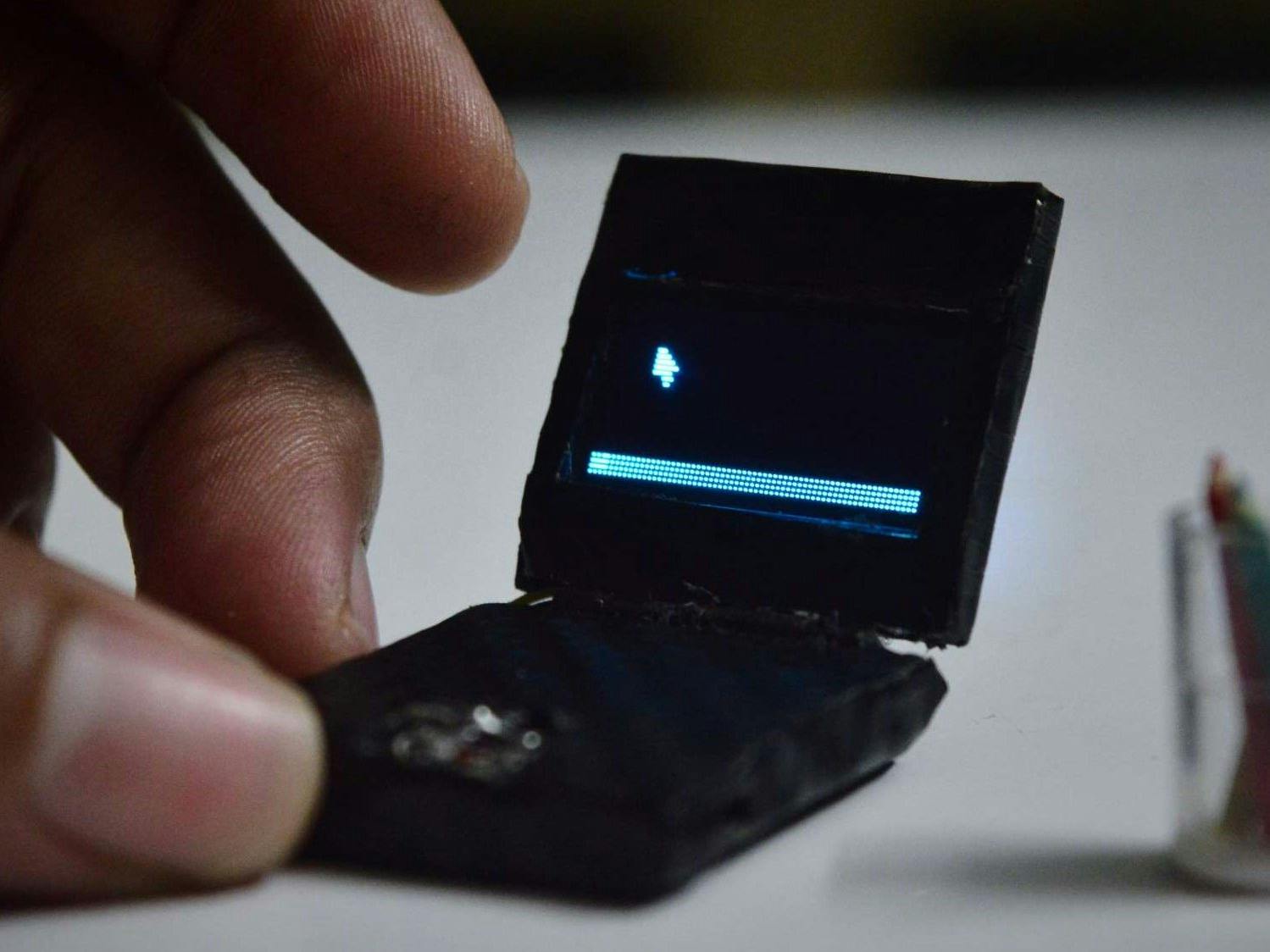
Fitting the physical build
The physical envelope had almost no margin. The screen is a 128×64 monochromatic OLED talking over I2C. The power comes from a micro lithium battery salvaged from an LED light, wired to an onboard charging port. The four directional inputs are custom-built tactile switches made from spring-loaded contact wires, behaving like a micro directional pad.
The base and screen lid are connected using a tiny metal hinge salvaged from an old eyewear case. The exposed wiring, ISP programming header pins, and extra GPIO ports were routed and secured using hot glue and textured vinyl wrap so the laptop can open and close like a real notebook.
4KB of ROM and a Snake game
The hardest part was not the soldering. It was the memory. The microcontroller on hand was an ATtiny44, which provides only 4KB of program flash ROM and 256 bytes of SRAM. In an 8-bit AVR with no graphics hardware, 4,096 bytes has to hold the display communication protocol, frame buffer logic, font glyphs, switch debouncing, and game state.
Standard Arduino display libraries were too heavy to compile. I had to write lean, direct byte-level drawing routines to squeeze a fully playable Snake game into the flash memory with bytes to spare.
What embedded constraints teach
Severe constraints clarify what is essential. When you have four kilobytes and four buttons, every pixel and every line of code has to earn its place. That discipline carries directly into software and interface design: remove what is non-essential until only the core task remains.
The full project write-up, schematics, and pinout details are documented on Hackster.