Systems Engineering6 min read
Booting iOS on Android Hardware: The Walled Garden Decoupled
For 17 years, iOS and Apple hardware were an indivisible monolith. An open-source breakthrough running XNU and iOS 16 on Qualcomm Snapdragon silicon just shattered that assumption.
Ever since Steve Jobs unveiled the original iPhone in 2007, the foundation of modern mobile computing has rested on one theological premise: hardware and software are an indivisible monolith. You could not buy iOS without paying the hardware toll for an iPhone. Choosing your operating system meant choosing the exact glass, aluminum, and proprietary silicon it was welded to.
This week, that seventeen-year-old architectural wall finally cracked. In a viral demonstration on Twitter / X that quickly racked up millions of views, independent developers and systems researchers demonstrated authentic Apple iOS booting on commercial Android smartphones—including the Xiaomi Redmi Note 10 Pro, Redmi Note 12, Poco X5 Pro, and Nothing Phone.
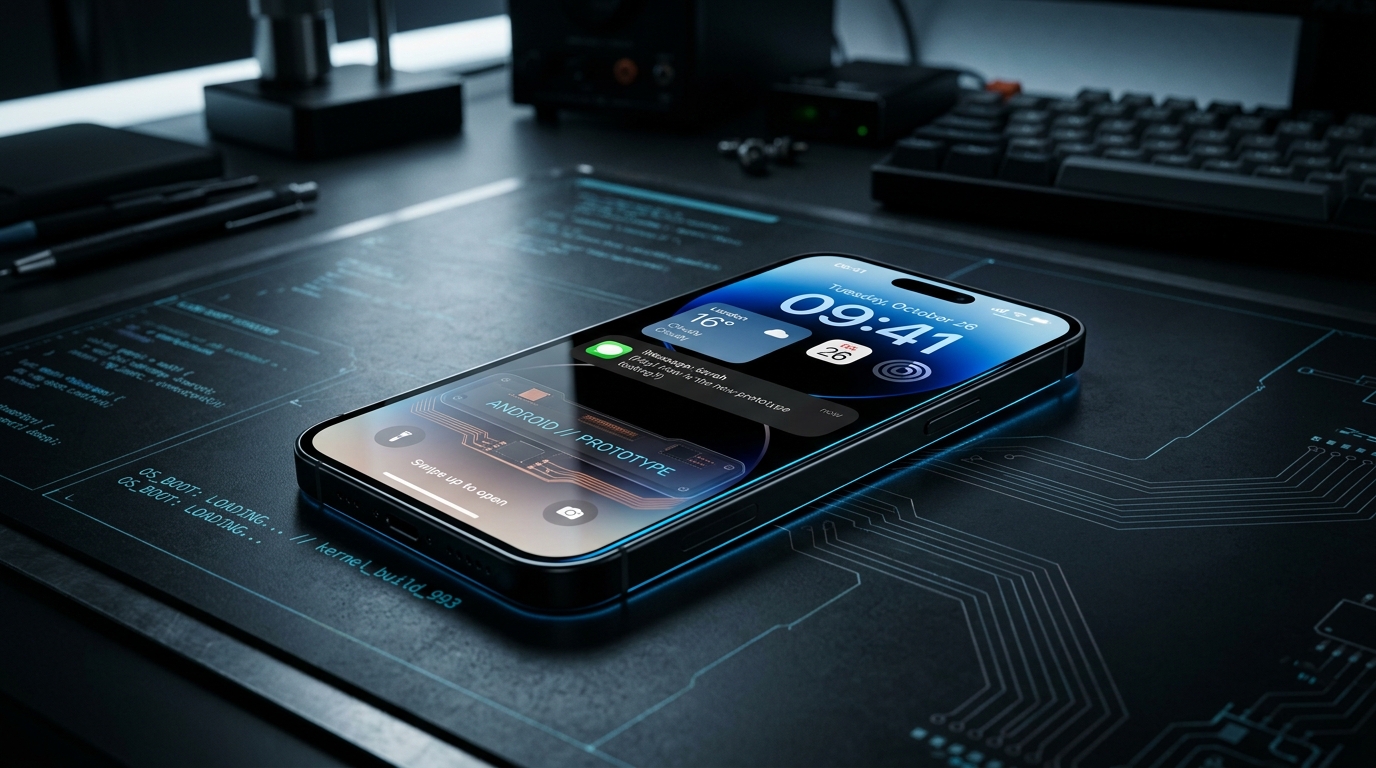
iOS 16 running on Android phone hardware (Redmi Note 12). Booting authentic Apple XNU kernel and unmodified iOS filesystem on Qualcomm Snapdragon silicon.
The asymmetric history of mobile porting
To understand why this is such a shockwave across the systems engineering community, you have to look at the asymmetric history of mobile platform porting.
We have seen Android ported onto iPhones before. Back in 2010, the legendary iDroid project allowed early iPhones to dual-boot Android 2.x. A decade later in 2020, security research firm Corellium introduced Project Sandcastle—leveraging the checkm8 bootrom vulnerability on Apple's A10 Fusion processor to boot Android 10 on an iPhone 7.
Going that direction was always feasible because Android is inherently built on an open Linux kernel designed to be adapted to heterogeneous hardware boards and arbitrary ARM platforms.
Going in the opposite direction—taking Apple's closed, highly proprietary iOS and transplanting it onto off-the-shelf Android hardware—was universally considered computing's impossible white whale. Apple does not write a generic OS. Every layer of iOS is deeply coupled to custom Apple Silicon: proprietary interrupt controllers, bespoke power management integrated circuits (PMICs), Apple GPU hardware, custom NVMe storage controllers, and the cryptographic enclave of the Secure Processor (SEP).
How it works: The boot architecture
As detailed by developers in the @0x0SojalSec's announcement thread on Twitter / X, the bring-up relies on a remarkable chain of open-source components and binary shims:
- Custom UEFI Firmware: Because Android devices lack Apple's proprietary iBoot bootloader, developers leveraged custom Tianocore / EDK2 UEFI firmware implementations ported to Qualcomm Snapdragon processors. This firmware initializes memory tables, configures ACPI devices, and hands execution over to the kernel.
- Patching the XNU Kernel: Apple openly publishes source code for the core XNU kernel as part of its open-source distributions. Projects like ios-sweet took Apple's XNU source and engineered patches to map memory, CPU registers, and interrupts to Qualcomm's Snapdragon 732G (Kryo 470 / ARM64 cores).
- Mounting Unmodified iOS 16 Rootfs: Resting directly on top of the patched XNU kernel is an unmodified root filesystem extracted from an official iOS 16.7.16 / 16.5 image (such as an iPhone X restore bundle). Once the kernel mounts the root APFS image, it executes standard launchd, spawning SpringBoard, the CoreServices daemon, and the UIKit rendering stack.
The result is astonishing to watch: an authentic iOS lock screen, home screen app grid, Control Center swipe gestures, and Settings menus booting and responding directly on a $200 Android handset.
The reality check: What actually works
As someone who spends significant time building hardware prototypes and embedded systems, I believe in looking at technical milestones with clear-eyed realism. This is an experimental proof-of-concept bring-up, not a daily driver you can switch to tomorrow.
Community testing and subsequent recordings (including the OOSexGang Poco demo on Twitter / X on a Poco X5 Pro) reveal both the engineering breakthrough and the current hardware boundaries:
- Interactive Touch & Hardware Buttons: Capacitive multi-touch input and physical volume/power buttons are successfully mapped and responsive.
- Software-Rendered Framebuffer: Because Apple's Metal graphics pipeline expects Apple GPU silicon, there is zero hardware 3D graphics acceleration. The display is drawn entirely by the CPU via software rasterization at approximately 20 to 30 frames per second.
- Dormant Peripherals: Wi-Fi, Bluetooth, cellular baseband modems, audio DACs, and cameras currently have no compatible drivers and do not function.
- Cold Boot Latency: The initial boot sequence spends four to five minutes sitting on the Apple logo while memory mappings and userland daemons resolve.
- Security & Storage: Installing this firmware completely wipes the phone's Android user partitions and leaves iOS system security integrity protections disabled.
In short: you cannot make phone calls, listen to music, or browse the web without a network stack. But in systems software, reaching an interactive userspace from zero is 90% of the battle. Driver engineering is simply the remaining 10% of grinding.
Why now? The AI reverse engineering catalyst
The fundamental question is: why did this breakthrough happen now, in late 2026, after nearly two decades of stalled attempts? The answer lies in the dramatic evolution of modern reverse engineering tooling.
Historically, porting a proprietary kernel required small teams of elite security researchers spending years manually staring at Ghidra or IDA Pro disassemblies, hand-crafting register mappings, and guessing undocumented hardware interfaces through trial and error.
Today, that workflow has been transformed by AI-assisted decompilation and automated reverse engineering toolkits (like REA). Systems engineers can feed proprietary Mach-O binaries, Apple DriverKit headers, and Snapdragon hardware registers into LLM-driven binary analysis pipelines. These tools can identify ABI mismatches, suggest driver shims, and diagnose fatal kernel panics in minutes instead of months.
Coupled with a surge in low-level iOS research—such as recent demonstrations of reboot-persistent kernel root access at Hexacon—the barrier of entry to dissecting Apple's operating system internals has collapsed.
Why this is a monumentally big deal
It is easy to dismiss an experimental OS port running at 25 frames per second with no Wi-Fi as a novelty for hackers. That would be a profound mistake. This milestone carries seismic implications for the future of mobile computing:
- The Decoupling of Mobile Hardware and Software: In personal computing, the separation between hardware and the OS created the entire computing revolution—x86 machines can run Linux, Windows, or FreeBSD interchangeably. Mobile phones, however, have been trapped in two walled silos for twenty years. Demonstrating that iOS userland can execute on non-Apple ARM architectures proves that the hardware lock-in was never a technological impossibility; it was purely a commercial contract.
- The Mobile Hackintosh Era: In 2005, when Apple transitioned the Mac to Intel x86, hobbyists realized OS X could be booted on standard PC components, sparking the Hackintosh movement. That movement transformed consumer expectations, educated an entire generation of kernel engineers, and pressured Apple to expand compatibility. We are standing at the exact dawn of that moment for mobile handhelds.
- Democratizing Mobile Security Auditing: Until now, auditing iOS internals required either thousands of dollars for specialized developer-fused research iPhones or costly cloud virtualization contracts. Being able to spin up real iOS userlands on $150 commodity Snapdragon handsets democratizes security auditing, vulnerability research, and penetration testing for independent researchers and students globally.
- Right to Repair and Hardware Longevity: Millions of pristine Android phones and older iPhones are abandoned as electronic waste every year simply because manufacturers stop shipping software updates. A modular future where users can install alternative kernels or operating systems across hardware vendors is the ultimate realization of hardware longevity.
Looking ahead
The path from a 20-fps proof-of-concept to a smooth, fully accelerated operating system is formidable. It will require reverse-engineering Adreno GPU acceleration, writing audio HAL bridges, and interfacing Qualcomm baseband modems with Apple's CommCenter daemon.
Yet the conceptual boundary has been crossed. The lock has been picked. For the first time in seventeen years, Apple's software is no longer welded to Apple's hardware—and the future of mobile computing will never look quite the same again.