AI Systems2 min read
Designing for autonomous agentic workflows and multi-agent UIs
A design framework for multi-agent systems: moving beyond single-turn chat boxes into proactive state machines, supervisor loops, and human-in-the-loop control surfaces.
We are transitioning from the era of conversational assistants into the era of autonomous agentic systems. Instead of a single model responding to a prompt in 500 milliseconds, modern AI workflows deploy squads of specialized agents: an Orchestrator breaking down problems, a Research Agent gathering facts, a Code Agent drafting implementations, and a Critic Agent validating outputs.
This architectural shift shatters the conventional chat interface. You cannot manage a five-agent asynchronous background job through a linear vertical chat log. It overwhelms the user, obscures system state, and makes error recovery nearly impossible.
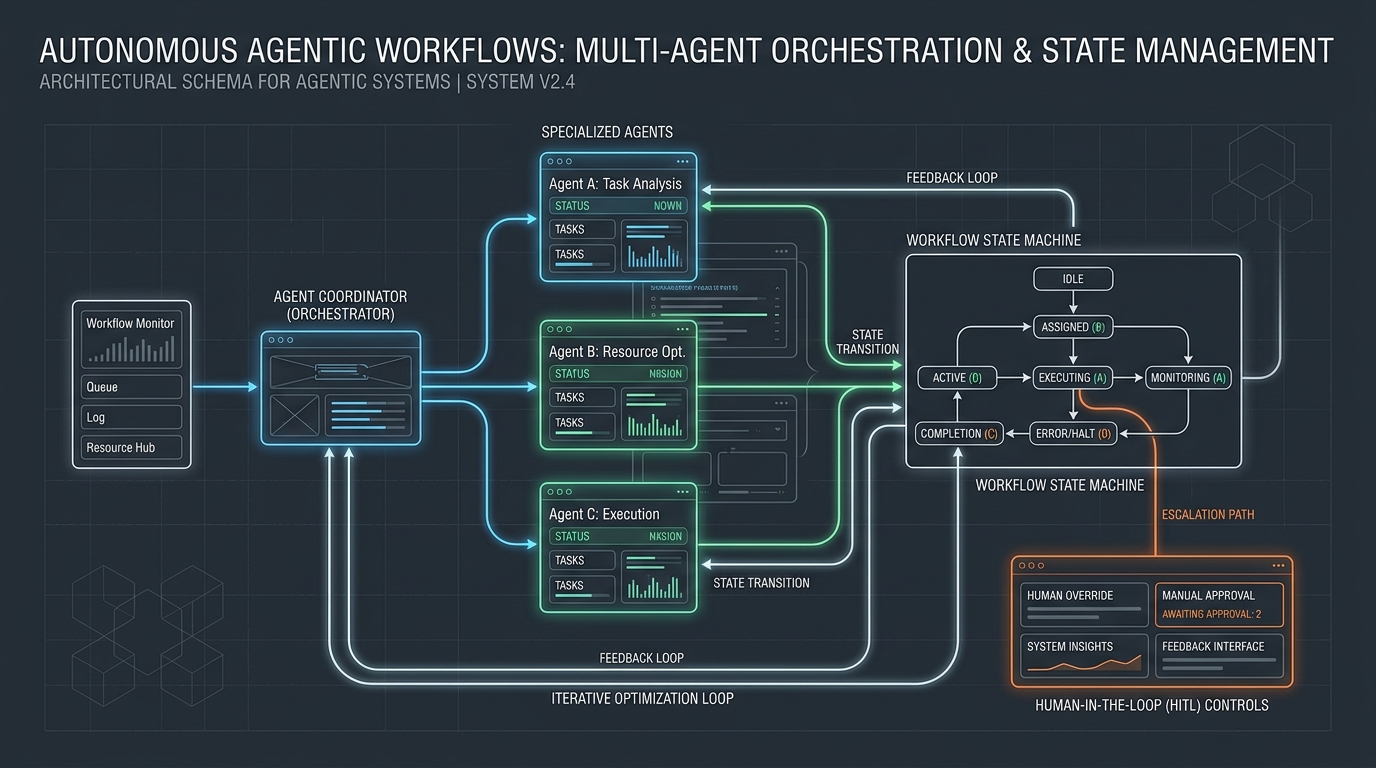
The supervisor loop and state visibility
When multiple autonomous agents operate in parallel, users need macroscopic visibility without microscopic fatigue. A product designer must answer three fundamental questions at every moment:
- What is the system currently doing right now?
- Which specialized agent is responsible for the active step?
- What decisions require human authorization before execution proceeds?
Human-in-the-Loop (HITL): Designing reversible escalation paths
Autonomous does not mean unsupervised. The most successful enterprise AI products establish crisp permission tiers. Read operations, web searches, and drafting are fully autonomous; destructive actions (committing code, transferring funds, publishing live pages, sending external emails) pause at an Escalation Gate.
These gates should not be modal popups that block the entire workspace. They should be compact, reviewable action cards containing a diff of the proposed action, expected impact, and one-tap options to Approve, Edit, or Reject with feedback.
From reactive prompts to proactive agency
For decades, software was strictly reactive: it waited for a human to click a button or type a query. Autonomous agentic systems invert this dynamic. They observe environmental changes, monitor pipelines, detect anomalies, and suggest preemptive interventions.
Designing for agency requires crafting notifications that communicate context instantly: 'I noticed your API response time degraded by 30% after the 2 PM deploy. I have prepared a rollback diff and root-cause summary. Would you like me to apply it?' That is the pinnacle of Human-AI collaboration—not replacing the human, but amplifying their leverage ten-thousand fold.