AI Systems3 min read
Resident Evil inside Doom: What happens when AI agents start merging games
A wild experiment showed an AI coding agent transplanting Resident Evil mechanics directly into Doom overnight. Here is why this changes game creation and software building forever.
If you grew up in the 90s, chances are you spent countless late nights terrified inside the Spencer Mansion of Resident Evil or blasting through the pixelated industrial corridors of Doom. And if you were anything like me, you probably wondered at least once: what would happen if you dropped Jill Valentine straight into the Doom engine?
For thirty years, that kind of crossover lived purely in our imaginations or required months of grueling, low-level engine hacking. But this week, a creator ran an experiment that genuinely stopped me in my tracks. Instead of writing custom code line by line, they gave an autonomous AI coding agent two massive source repositories: the open C engine of Doom (GZDoom) and the reverse-engineered decompilation of Resident Evil 1.
The prompt was as ambitious as it was simple: transplant Resident Evil's authentic mechanics directly into Doom. By the next morning, the agent had built a fully playable, spine-chilling vertical slice.
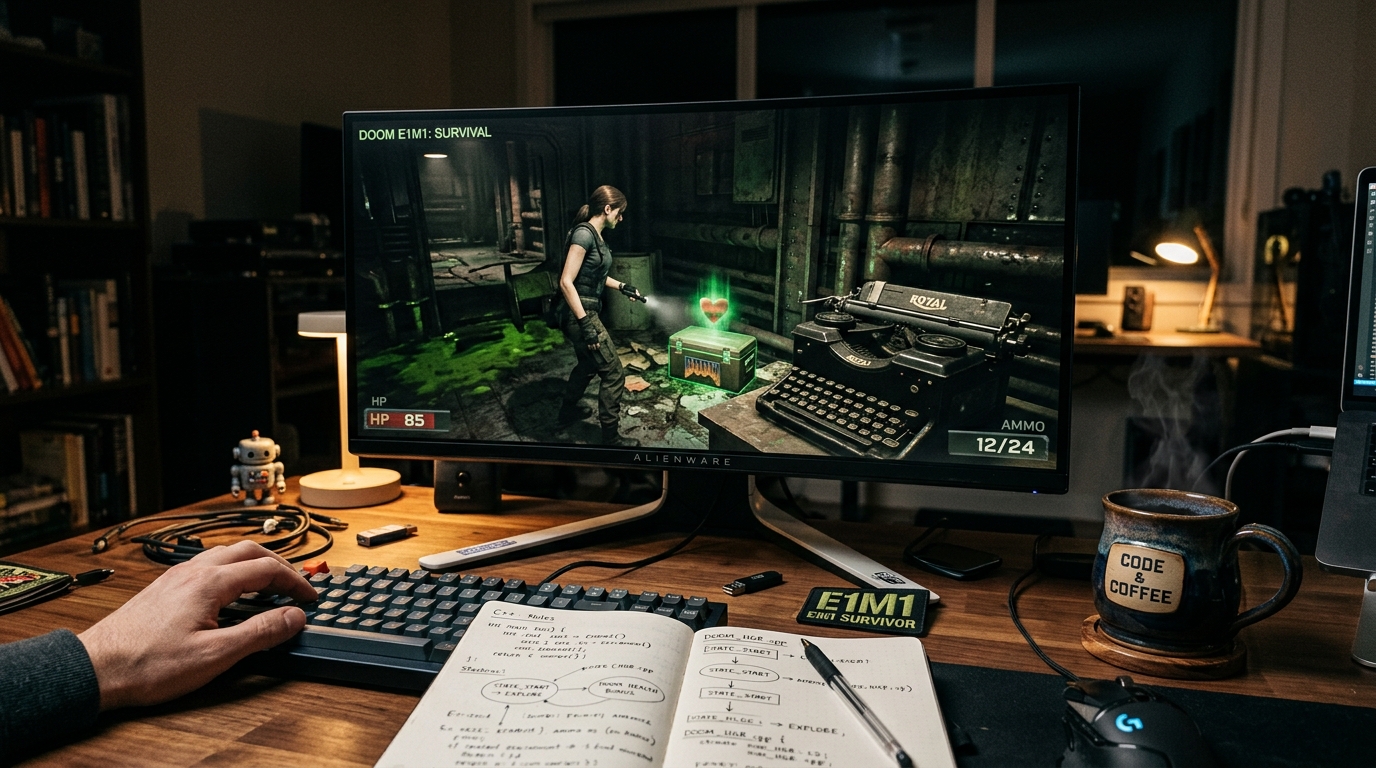
Not just a reskin—a true mechanical transplant
What makes this experiment so jaw-dropping is that the AI didn't just slap a 3D character skin over Doom's first-person shooter template. It systematically pulled the actual underlying logic from the decompiled C source code and re-architected it inside GZDoom:
- Authentic Tank Controls: The deliberate, tense turning physics and auto-aim mechanics that defined early survival horror.
- Fixed Cinematic Cameras: Doom's first-person viewport was swapped out for trigger zones that dynamically cut to fixed camera angles as you explore each room.
- Typewriters & Storage Boxes: The iconic Resident Evil save system, ink ribbons, and limited item inventory with persistent multi-room storage.
- Micro-Details: Shotgun shell ejection physics, authentic ammo counts, and sound triggers ported straight from the original game assets.
The magic of talking to AI with screen recordings
As cool as the game looks, the debugging workflow is what really gave me goosebumps. If you have ever written game code, you know that the most frustrating bugs are never simple syntax errors—they are subtle visual and spatial glitches that compiler logs cannot explain.
Instead of digging through terminal error logs or guessing memory pointers, the developer simply recorded a quick video of the gameplay and talked out loud: 'Notice how the camera snaps weirdly when she walks through this doorway, and the shotgun blast is hitting the floor instead of the enemy.'
The multimodal AI agent watched the screen recording, heard the voice commentary, spotted the visual discrepancy across the video frames, located the exact lines in the physics and camera routines, and committed the fix. It felt less like tedious programming and more like jamming with a senior developer sitting right beside you.
Why taste and creative direction matter more than ever
Whenever tools like this go viral, people inevitably ask: 'Does this mean anyone can just say an idea and make a masterpiece?'
In reality, the opposite is true. When the friction of writing code drops to zero, execution is no longer the bottleneck—taste, scope, and systems architecture become everything. If you ask an AI to 'make a cool horror game,' you will get generic, soulless slop.
What made this project extraordinary was sharp creative vision: taking two legendary, contrasting classics, providing concrete decompiled source code as ground truth, and having the design sensibility to know exactly how the game should feel to play.
The bigger picture: Building at the speed of thought
While retro game mashups are wildly entertaining, the implications for product design and software engineering are massive. The exact same agentic workflow that merges Resident Evil into Doom can migrate decades of legacy enterprise code, connect disparate APIs, or turn a rough napkin sketch into an interactive prototype in hours.
We are standing at the threshold of a new era of software creation—where the barrier between an idea and a living, playable reality has never been thinner. And as designers and builders, that is the most exciting world we could ask for.