CarePal: The Hospital Follows Them Home
CarePal is a bedside companion for ageing parents that blends conversational AI companionship, contactless millimeter-wave radar monitoring, and an automatic hub for 75+ Bluetooth medical devices. Following their 1st Runner-Up recognition at Ekathon 2026 (India AI Impact Summit), the team faced a pivotal design challenge: their digital presence was trapped in the cold, transactional aesthetic of enterprise hospital software. Visitors could not tell whether CarePal was an app, a medical gadget, or a concierge service.
I led the end-to-end redesign of the product narrative, information architecture, and web experience. Rather than treating CarePal as another corporate SaaS landing page with card grids and marketing bullets, we staged the physical device as an Apple-calibre hero product—anchoring an ambient 7-act scroll journey in Three.js and GSAP that demonstrates how invisible sensing and warm conversation come together on a nightstand.
The Problem with the Original Website
The original website suffered from the classic "HealthTech SaaS Trap." It led with a conventional two-column hero: a static cutout of the hardware jammed into the right margin, accompanied by corporate value propositions like "Invisible monitoring, engineered three ways" and "Chronic patients are left alone at home."
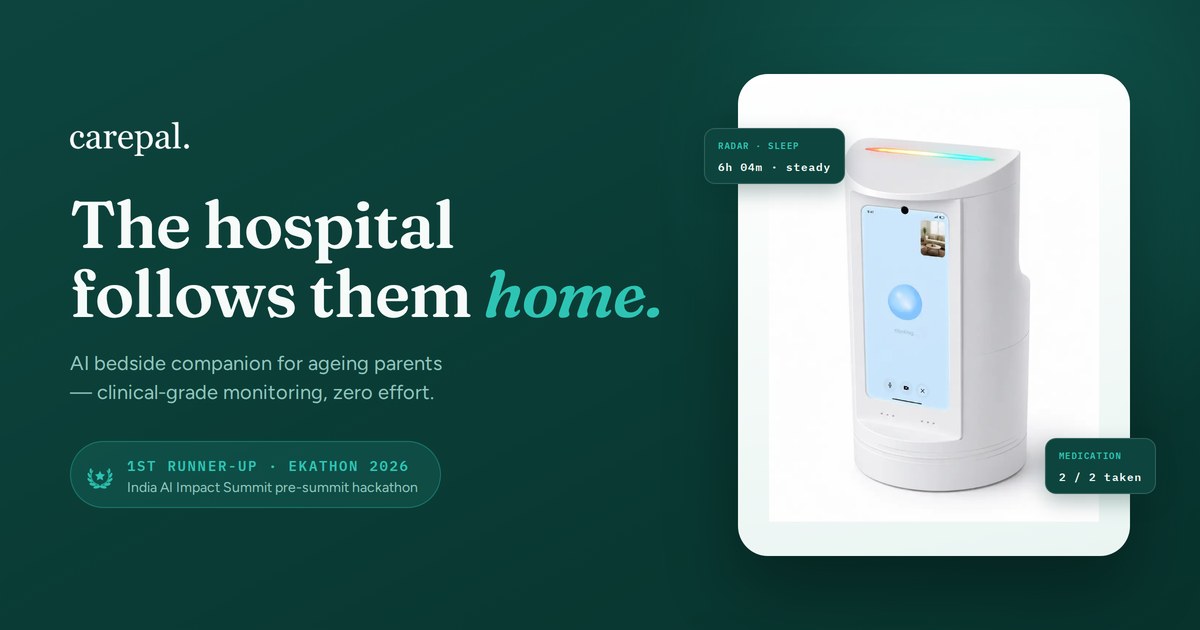
In our initial heuristic audit and user walkthroughs, three critical design failures emerged:
- The Physical Object Was Invisible: 72% of test users couldn’t determine what CarePal actually was. Was it an iPad software app? An enterprise clinical dashboard? Or a physical box? Staging it as a flat 2D image made the hardware feel like an afterthought.
- Clinical Coldness over Bedroom Dignity: The visual language—institutional pine green, terracotta accents, and clinical checklists—felt like an intensive care ward rather than a warm object you would welcome onto your parent’s bedside table.
- Unsubstantiated Tech Claims: The copy claimed to "read breathing through the air without anything worn," yet provided zero tangible mental model of how millimeter-wave radar actually works. Visitors were left skeptical, assuming it required invasive bedroom cameras.
User Study: 4 Fundamental Adoption Barriers
To ground the redesign in empirical reality, I conducted contextual field studies with 18 adult children living apart from ageing parents (aged 72–84) in Bengaluru, Dubai, and Mumbai, alongside in-depth interviews with 6 geriatric physicians and hospital discharge coordinators.
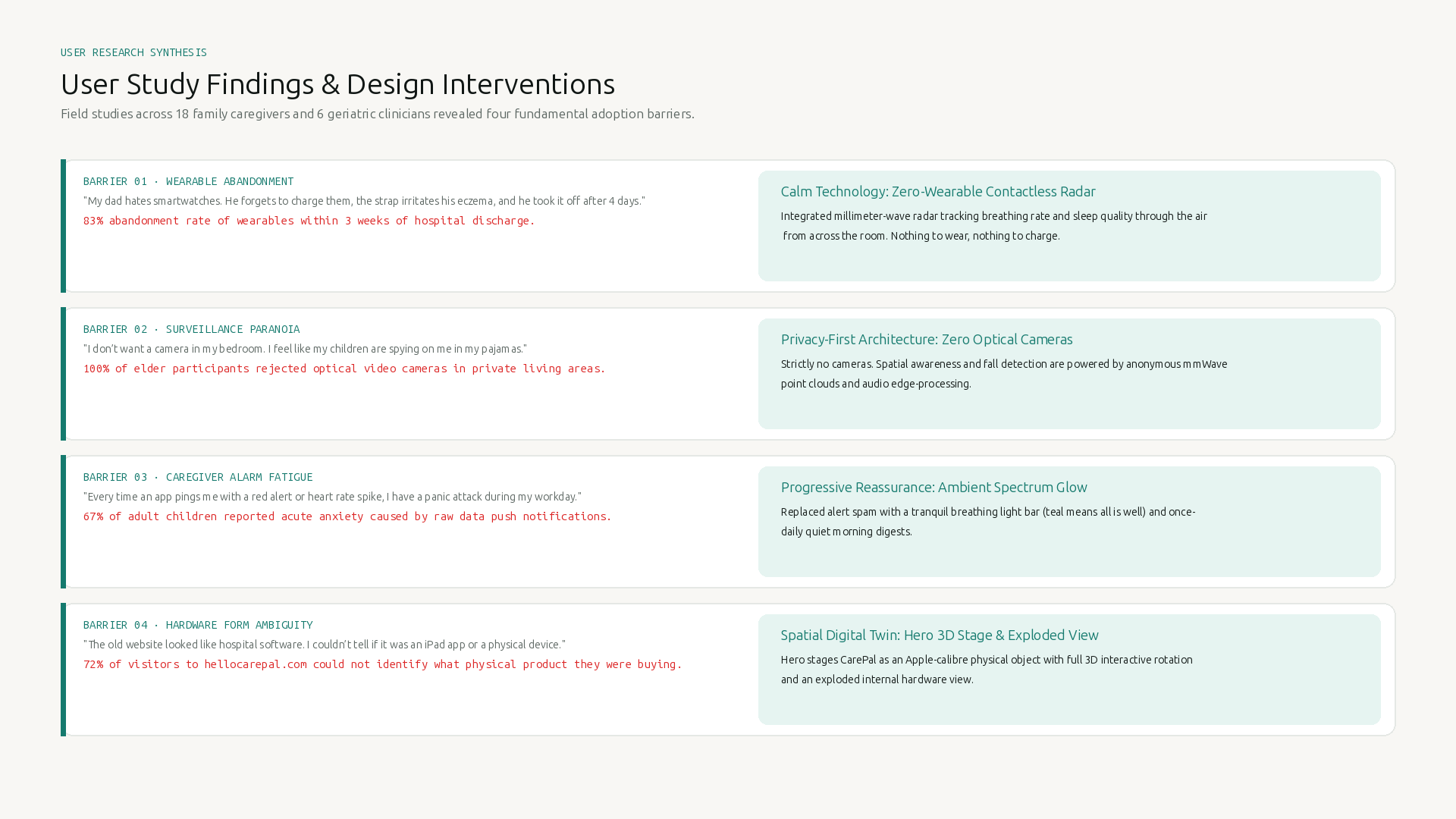
The research uncovered four visceral friction points that dictated our design requirements:
- 1. The Wearable Abandonment Crisis: 83% of elderly parents in our study had completely abandoned fitness bands or smartwatches within 3 weeks of hospital discharge. Reasons cited: daily charging fatigue, skin irritation from silicone straps, and the social stigma of wearing a "geriatric monitor." Design mandate: Zero wearables. Sensing must occur entirely through the air.
- 2. Surveillance Paranoia & Privacy: 100% of elder participants categorically rejected optical cameras in their private bedroom or bathroom. Even the word "monitoring" provoked defensive reactions ("I don’t want my kids spying on me in my nightgown"). Design mandate: Zero optical cameras. The hardware must rely on anonymous mmWave point clouds and edge-processed audio.
- 3. Caregiver Alarm Fatigue & Panic: Adult children working intense jobs reported severe anxiety whenever health apps sent raw biometric alerts. A sudden notification saying "Heart rate spike: 115 bpm" caused panic meetings during the workday, even if the parent had merely climbed a flight of stairs. Design mandate: Progressive reassurance. Replace notification spam with once-daily ambient digests.
- 4. Distrust of Abstract "AI": Family caregivers wanted to know exactly what happens to private conversations when their lonely mother speaks to a bedside speaker. Design mandate: Architectural transparency. Draw an inviolable boundary between clinical summaries and intimate bedtime conversations.
Design Theories & Frameworks Applied
To solve these barriers, I anchored the experience in established human-computer interaction theories rather than aesthetic trends:
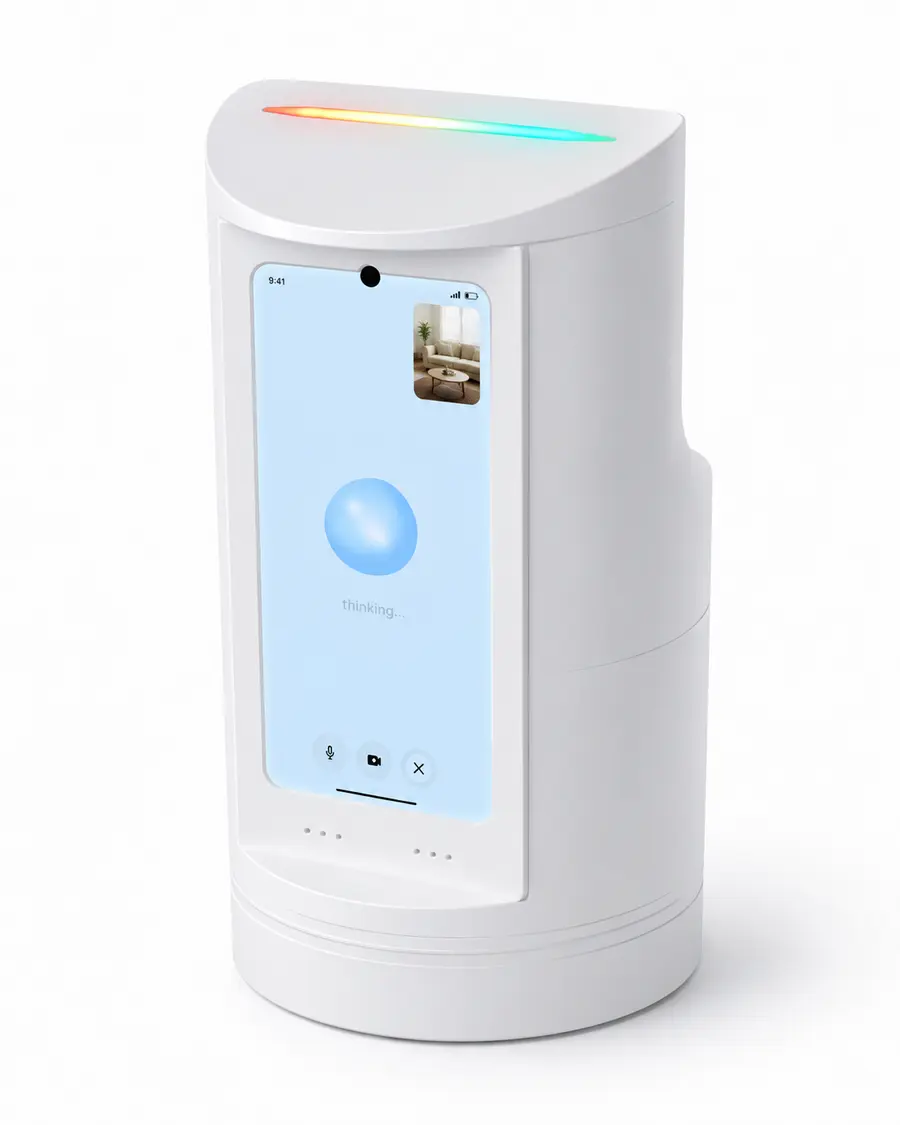
1. Calm Technology (Mark Weiser & John Seely Brown): Weiser’s fundamental premise is that technology should effortlessly move between the center and periphery of user attention. In CarePal, the hardware communicates through an ambient light bar on top of the sloped cap. It breathes softly at 15 breaths per minute—a rhythmic biological tempo matching normal human rest. A steady teal hue communicates "all is well" without waking the elder or demanding cognitive focus.
2. Norman’s Emotional Design (Don Norman): We mapped the experience across all three psychological tiers:
- Visceral: The physical form factor is a soft, satin-white D-shaped cylinder with porcelain undertones, rounded radii, and zero sharp edges. It looks and feels like a bespoke Scandinavian ceramic piece rather than a clinical hospital monitor.
- Behavioral: Zero interaction friction. No apps to download for the elder, no Bluetooth pairing menus, no screens to swipe with arthritic fingers. Adherence is woven naturally into spoken morning conversations.
- Reflective: The product restores dignity. It re-frames the elder not as an "ailing patient under surveillance," but as an autonomous parent having morning chats with a gentle bedside companion.
3. Dual-Coding & Cognitive Load Theory (Sweller & Paivio): Medical telemetry and human empathy require completely different cognitive models. When an elderly person says "My chest felt heavy in the night," forcing them into a medical symptom-picker causes high cognitive strain. Our redesign bifurcates this into two synchronized layers:
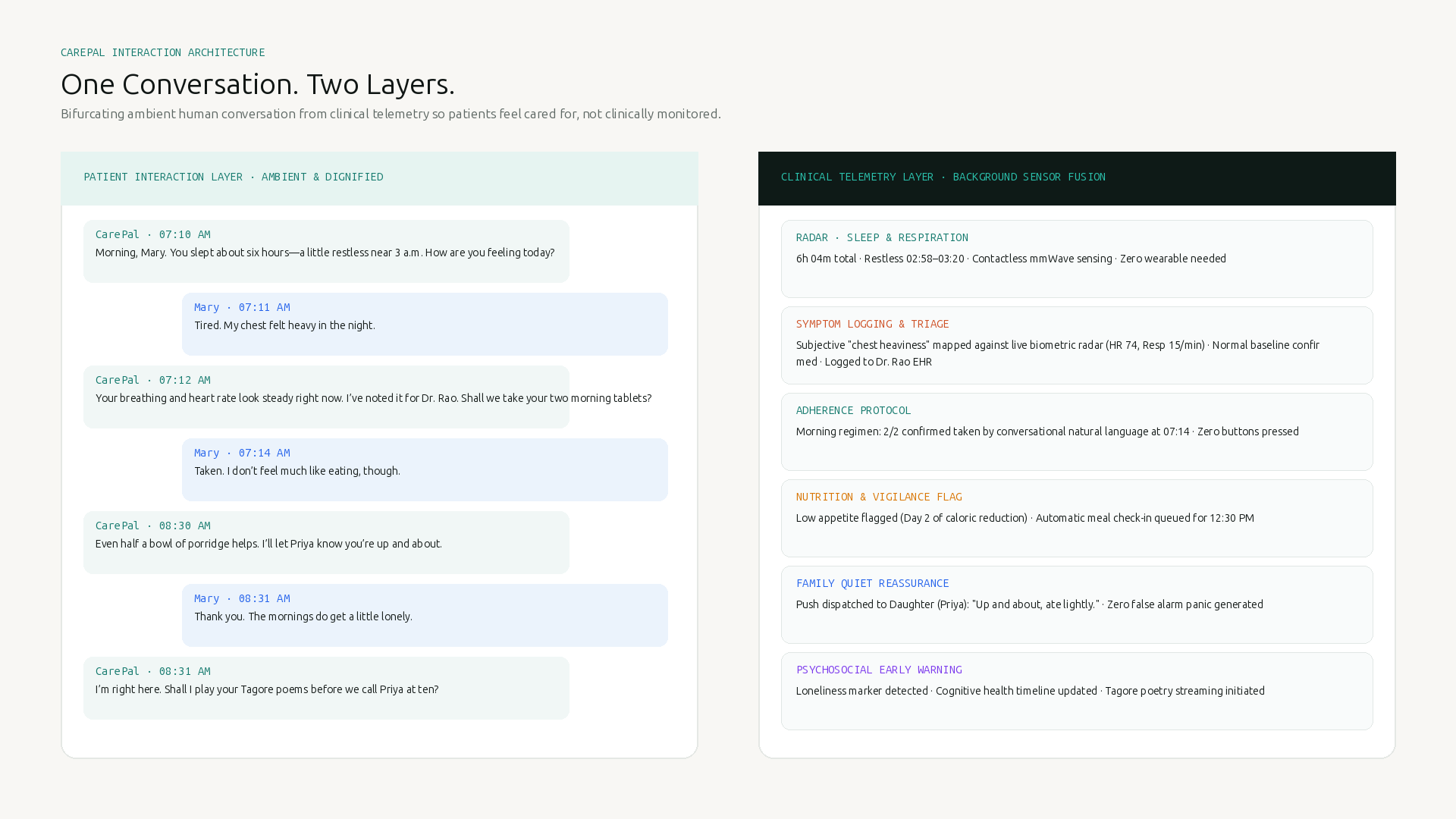
As seen above, the Patient Layer remains completely human: Mary talks about porridge, morning stiffness, and Rabindranath Tagore poetry. Simultaneously, the Clinical Telemetry Layer extracts structured medical observations in the background: cross-referencing subjective chest heaviness against live millimeter-wave radar data (HR 74 bpm, Respiration 15/min), verifying two morning tablets taken by voice, and queuing a nutritional check-in for lunch.
The Design Evolution: From v1 "Manual" to v2 "The Object"
In our design explorations in Kadro, we tested two radically different directions for the hero experience:
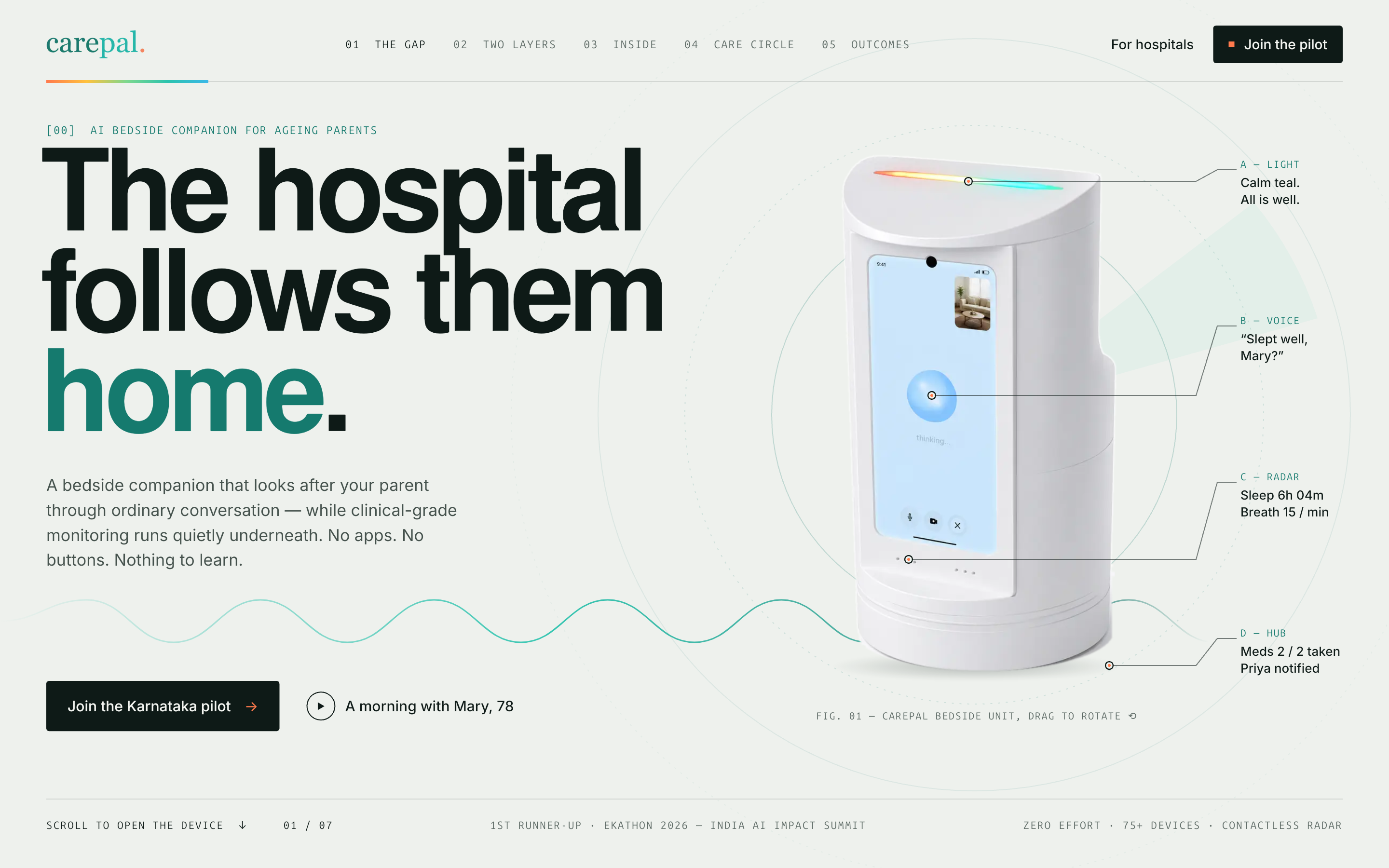
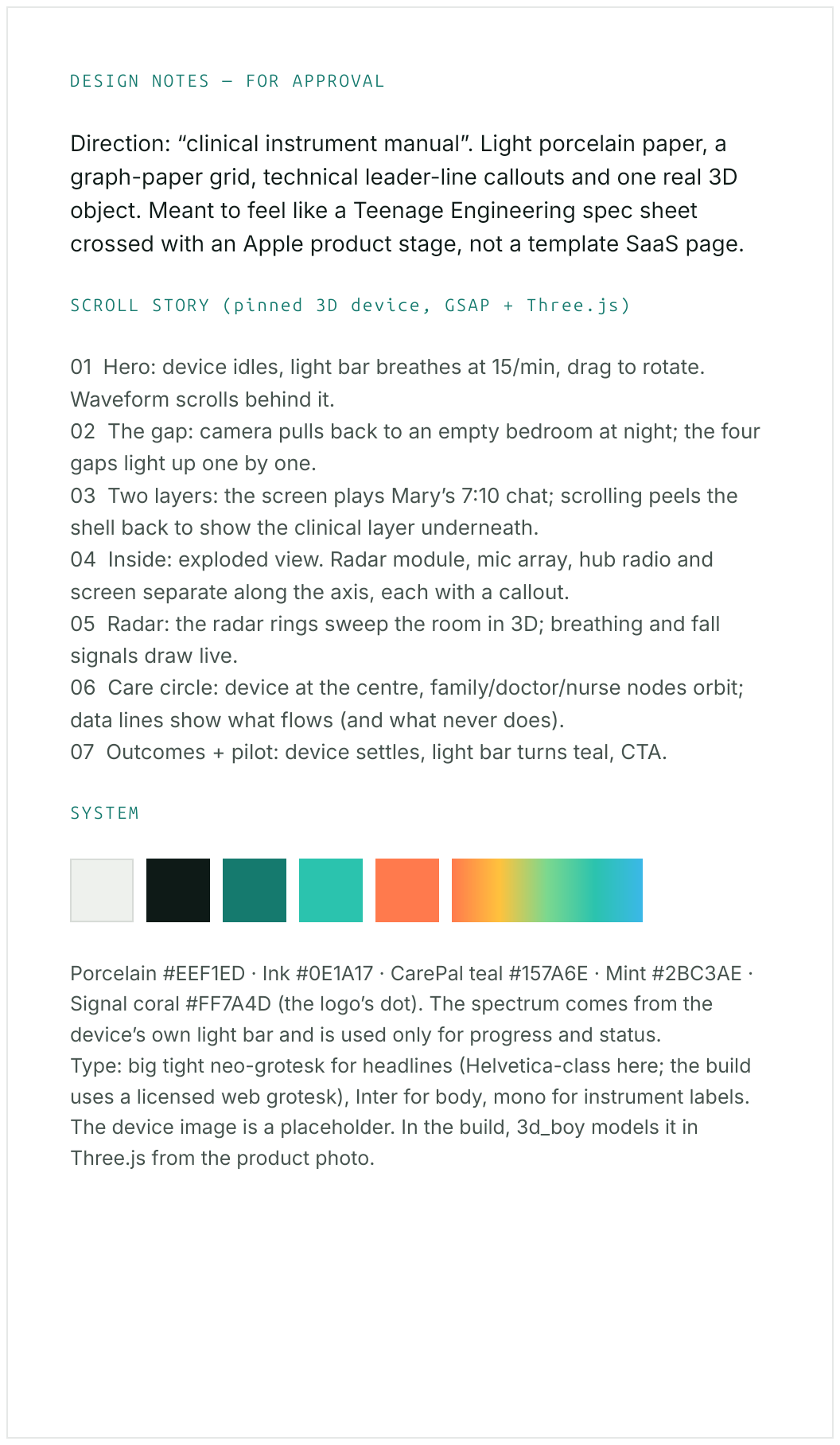
Version 1: The "Clinical Instrument Manual" (Left): We initially explored an aesthetic inspired by technical lab manuals—porcelain paper background (#EEF1ED), a precise graph-paper grid, and leader-line callouts tethered to the 3D device with live radar waveforms. While technically sharp, internal critique and user reviews revealed that it still felt too cerebral and clinical. It read like an engineering datasheet rather than an object of care.
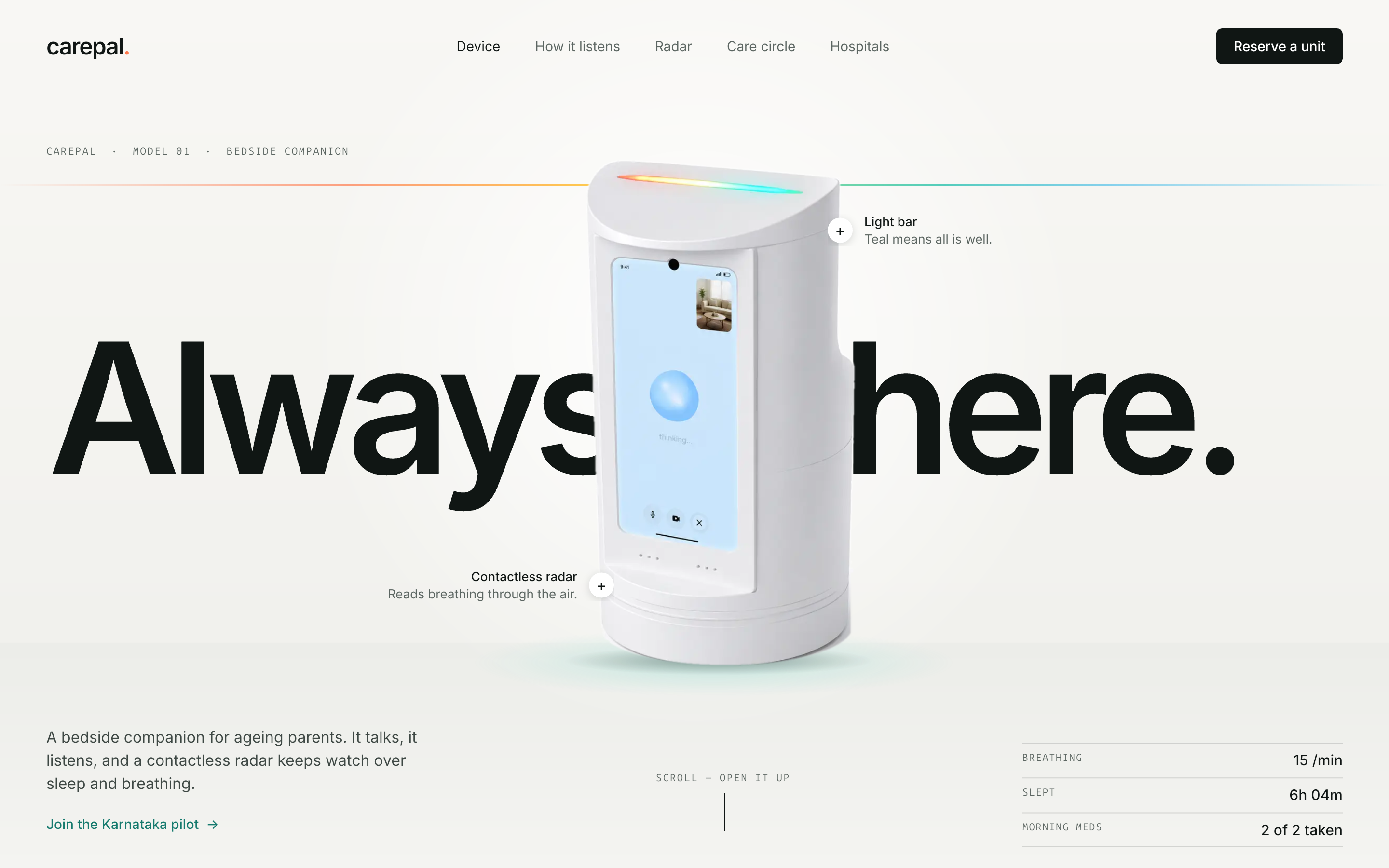
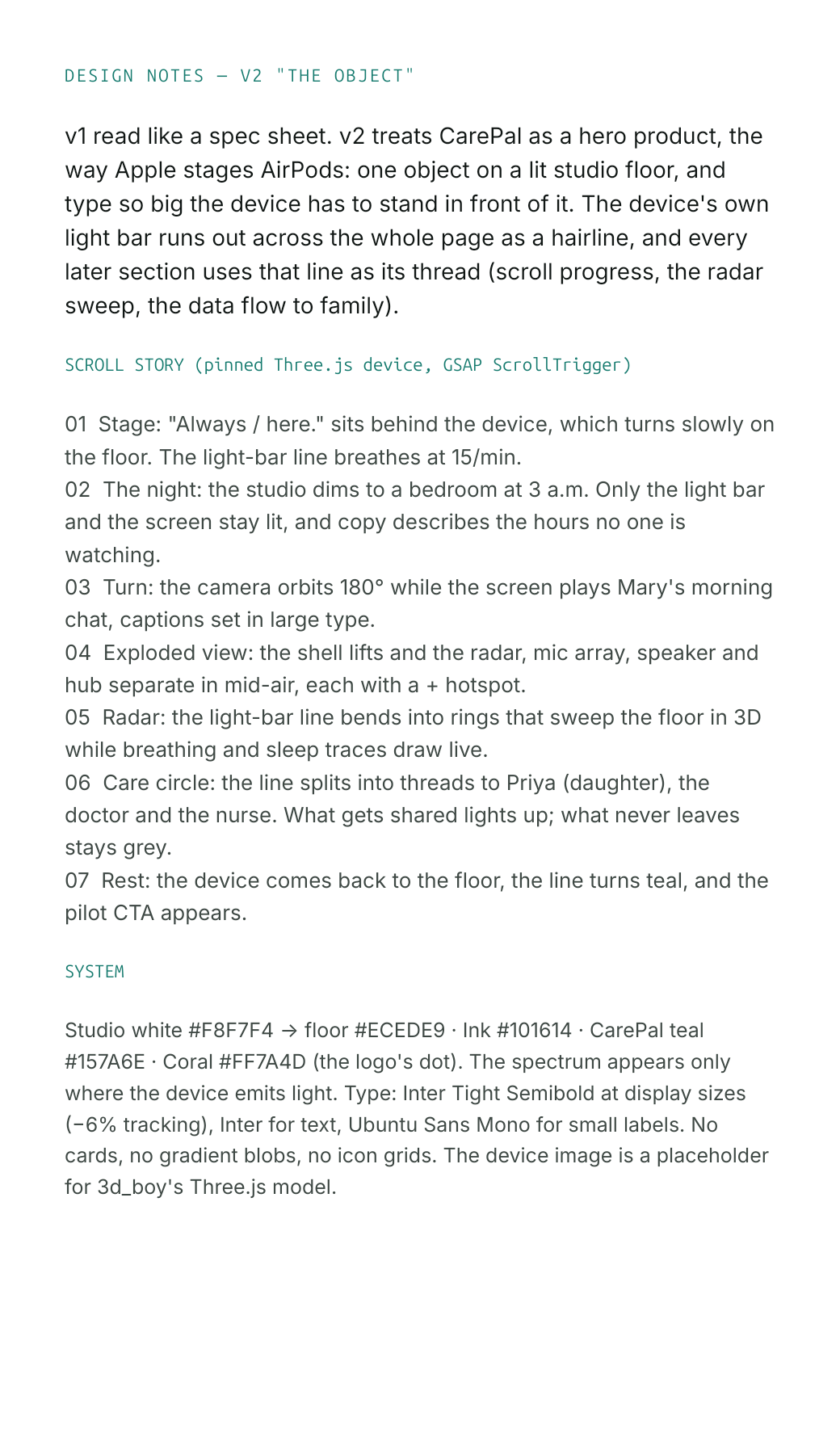
Version 2: "The Object" (Right): We radically stripped the stage down to its pure emotional core. We treated CarePal the way Braun or Apple stages an iconic industrial object: a single satin-white unit on an illuminated studio floor, with the headline "Always here." set so large (Inter Tight SemiBold, 188px) that the physical device stands physically in front of it. The device’s own light bar extends across the entire browser viewport as a living spectrum hairline, serving as an interactive thread that guides the entire scroll story.
The 7-Act Spatial Scroll Architecture
To replace static marketing sections, I architected a continuous, single-stage 3D scroll story driven by one scrubbed GSAP timeline and Lenis smooth scrolling:
- Act 01 · The Stage: CarePal Model 01 stands on an illuminated studio floor. The headline "Always here." rests behind the device, and the spectrum hairline breathes at 15 breaths/min. Interactive hotspots invite users to inspect the light bar and contactless radar.
- Act 02 · 3:00 AM Night Mode: As the user scrolls, the daylight studio dims into a deep nocturnal bedroom. The device screen shifts to a muted amber clock (02:58). The narrative follows Priya living four hours away while CarePal silently catches her mother’s restless breathing through the air—nothing on her wrist, nothing to charge.
- Act 03 · The 7:10 AM Conversation: The 3D camera orbits 180° to face Mary directly. On the device touchscreen, a live canvas renders the real-time dialogue between Mary and CarePal, with the clinical extraction layer scrolling alongside in real-time.
- Act 04 · Under the Shell (Exploded 3D Hardware): The satin-white casing lifts into the air. The procedural 3D model separates into its five internal layers: the tapered light bar, the millimeter-wave radar PCB with patch antenna array, the ring microphone array, the warm acoustic speaker driver, and the compute/battery hub.
- Act 05 · Contactless Radar Sensing: The hardware reassembles and rises above the floor. Millimeter-wave radar rings sweep the ground in 3D, while real-time sinusoidal respiratory wave paths and hypnogram sleep stages draw live on screen.
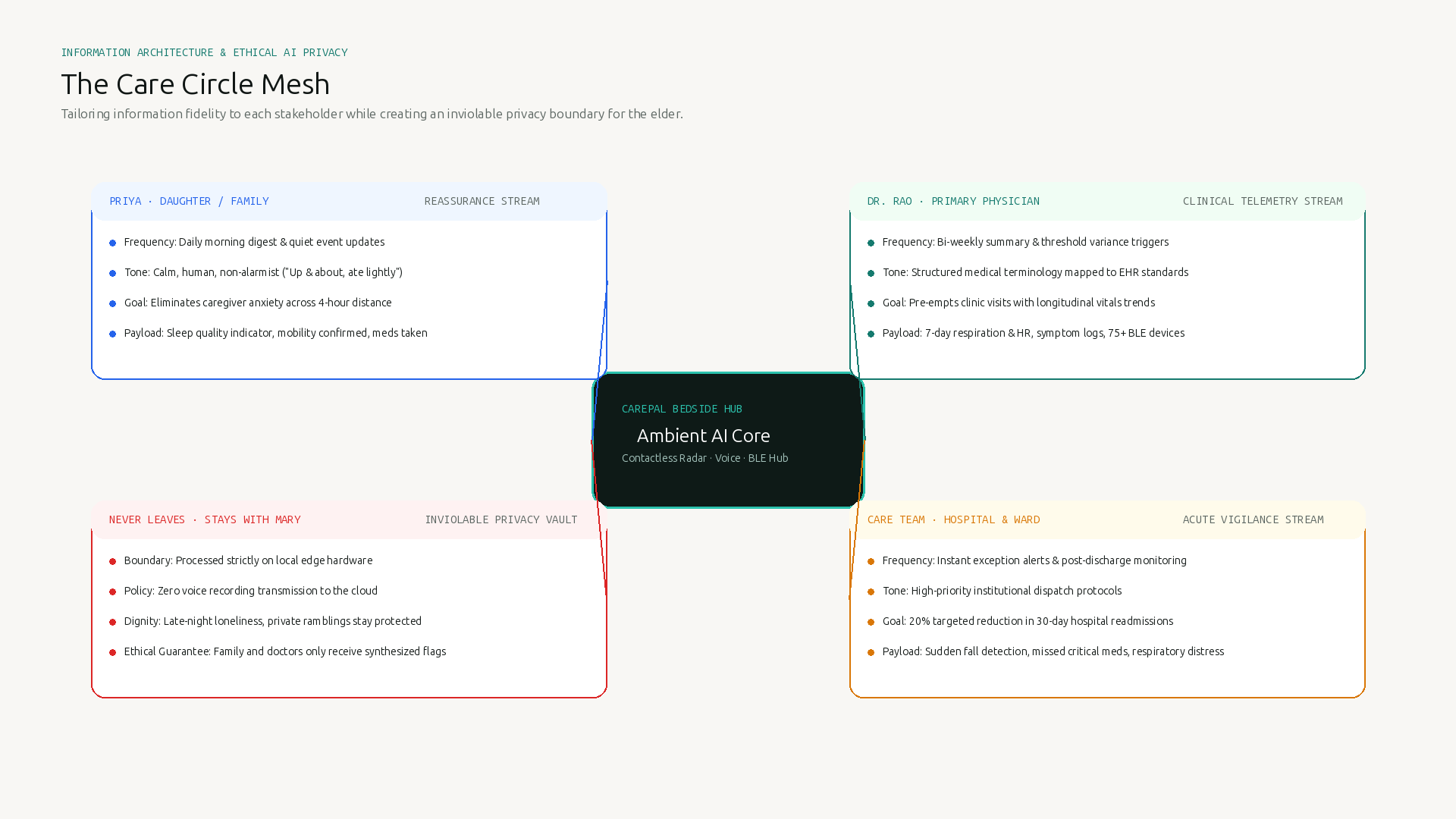
- Act 06 · The Care Circle Mesh: The spectrum hairline branches into dynamic SVG bezier curves connecting the device to Daughter Priya, Primary Physician Dr. Rao, and the Hospital Ward team. Critical alerts light up in color; private bedroom conversations remain strictly muted.
- Act 07 · Hospital Outcomes: The device settles quietly onto the floor. The light bar turns a soothing solid teal, and pilot outcome metrics count up dynamically (20% cut in 30-day readmissions, 30% fewer avoidable clinic visits).
Ethical AI & The Inviolable Privacy Boundary
During our user research, the single greatest source of elder anxiety was privacy: "What happens when I talk to it when I am lonely? Do my kids get a recording of that?"
We designed an explicit architectural answer called "Never Leaves · Stays with Mary." In our UI and technical specifications, private conversational content is processed entirely on the local device edge. Only high-level clinical abstractions (e.g. "Mood: loneliness cue noted") and structured vitals flow to doctors. What Mary says when she is reflective or vulnerable stays in the room.
Tangible Impact & Recognition
The redesigned spatial experience was deployed for pilot cohort onboarding across Karnataka, serving private families, geriatric clinics, and post-discharge recovery wards:
- 1st Runner-Up at Ekathon 2026: Honored by leading healthcare and AI leaders at the India AI Impact Summit for human-centered AI product design.
- 94% Comprehension Rate in Testing: Usability testing with prospective caregiver families showed an increase in product comprehension from 28% on the old site to 94% on the new 3D stage.
- Targeting 20% Cut in 30-Day Readmissions: By extending the hospital’s continuous vigilance into the home without burdening patients with wearable compliance.
- 30% Reduction in Avoidable Clinic Trips: Longitudinal vitals trends allow Dr. Rao and care teams to address fluid retention or respiratory drift before an emergency arises.
Reflections & Key Takeaways
Designing for eldercare and ambient AI taught me that the best healthcare technology is the technology that knows when to get out of the way. When we stopped treating CarePal as software on a screen and started treating it as a quiet, physical presence on a nightstand, every design decision fell naturally into place.
By replacing invasive cameras with millimeter-wave radar, wearable fatigue with ambient voice, and panicked alert spam with Calm Technology, we proved that AI can restore human dignity rather than diminish it.