Agent Office
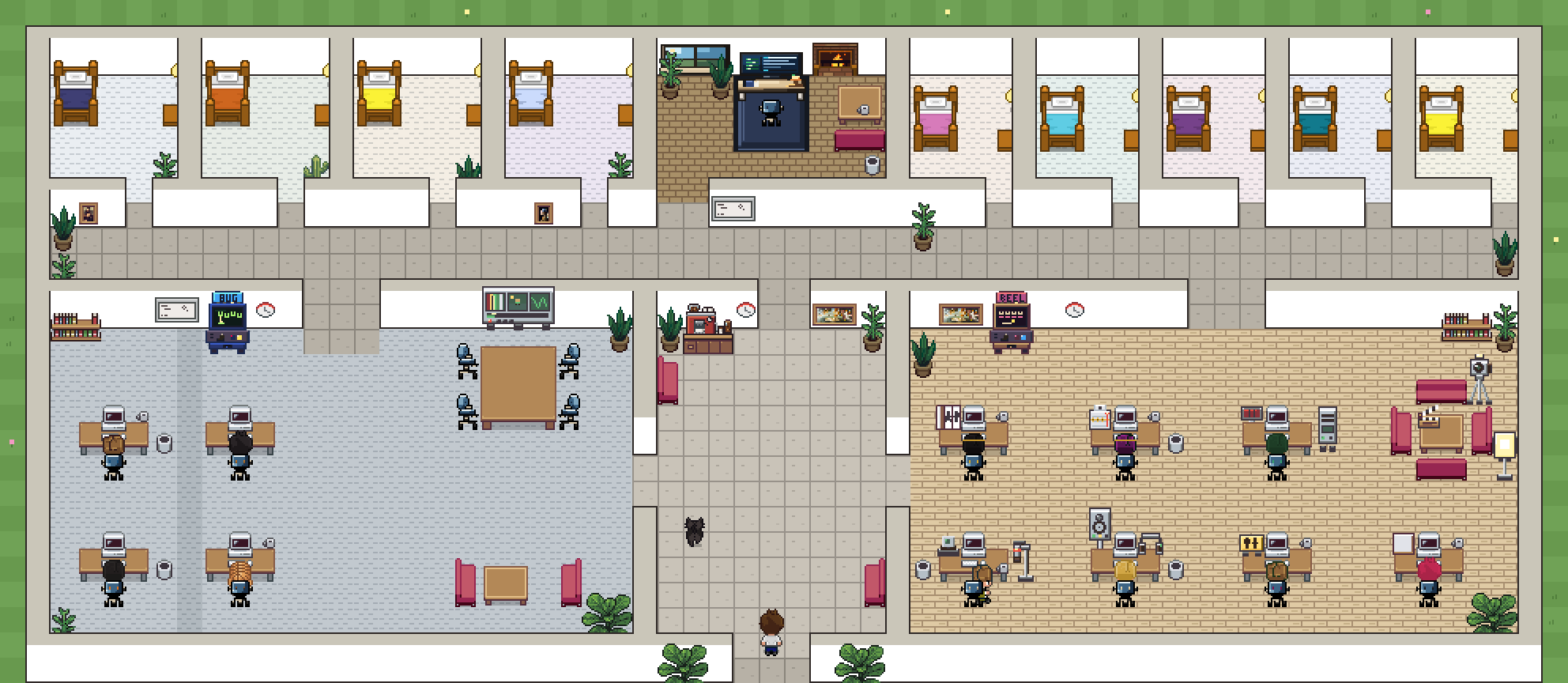
I pay for four AI coding tools: Claude Code, Codex, Grok Build and Google Antigravity. Each one is good on its own, but working with them meant four chat windows, one task at a time, and me in the middle copying context and checking whether anything was stuck.
I wanted them to work like a team I manage, not tools I babysit. Agent Office is the workplace I designed for them: a queue of tasks across all my projects, a pixel-art office where I can see who is working, and my phone for the moments they actually need me.
- 14 AI agents across a tech team, a creative studio, a hardware workshop and a media team
- 1,600+ tasks completed across 40 projects in the first six weeks
- Designed by me and built with AI coding agents, one stage at a time. The office's own agents now help maintain it
The problem
AI agents are fast, but the experience around them was built for one person and one chat. With a list of 20 projects, the bottleneck was never the agents. It was me.
- I couldn't see what was happening. An agent could be working, stuck or finished, and the only way to know was to go and look.
- When an instruction was unclear, agents guessed. A wrong guess cost more than the question would have.
- Heavy Android builds from two agents at once would freeze the laptop they all share.
- Their work goes straight to the main branch with no review step, so one careless command could rewrite a project's history.
Who it is for
I was the first user: one designer with many projects and no engineering team. That set the bar. I'm a designer, not a backend engineer, so every part had to be something I could understand, test myself and trust while I was away from my desk.
How I designed it
A queue, not a conversation
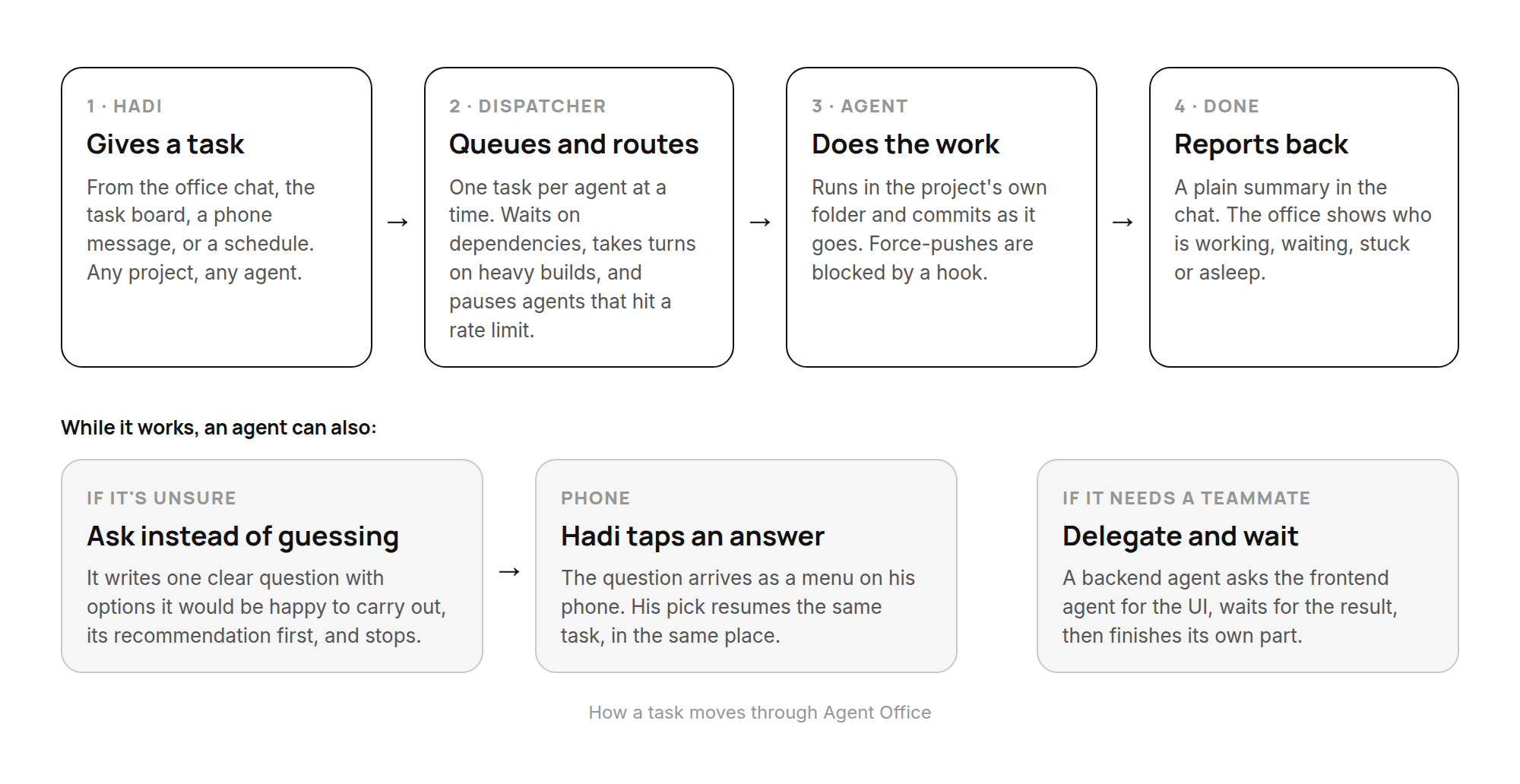
Every piece of work is a task with a project, an agent and a status: waiting, running, needs me, done or failed. Tasks can wait for other tasks. A dispatcher checks the queue every ten seconds and gives each agent one task at a time. If an agent hits its usage limit, it goes to sleep and the work waits for it instead of failing.
Ask, don't guess
The most important design decision was what happens when an agent is unsure. Instead of guessing, it stops and writes a question in a fixed format: a line of context, then a short list of options, its recommendation first. Every option has to be a complete answer it would be happy to carry out.
That format is what makes the question answerable on a phone. It arrives as a menu, I tap one, and the same task picks up exactly where it stopped. I can always type my own answer, but most of the time I don't need to. Designing the question, not the notification, is what made it usable.
Make the invisible visible
A dashboard of statuses tells you what is happening, but you have to read it. I wanted to understand the whole team at a glance, so the office is a place. Each agent has a desk, a bed and a spot in the lounge. An agent at its desk is working. An idle one wanders to the lounge. One asleep in its room has hit its usage limit and says when it'll be back. One that needs me stands up at its desk and turns to face me.
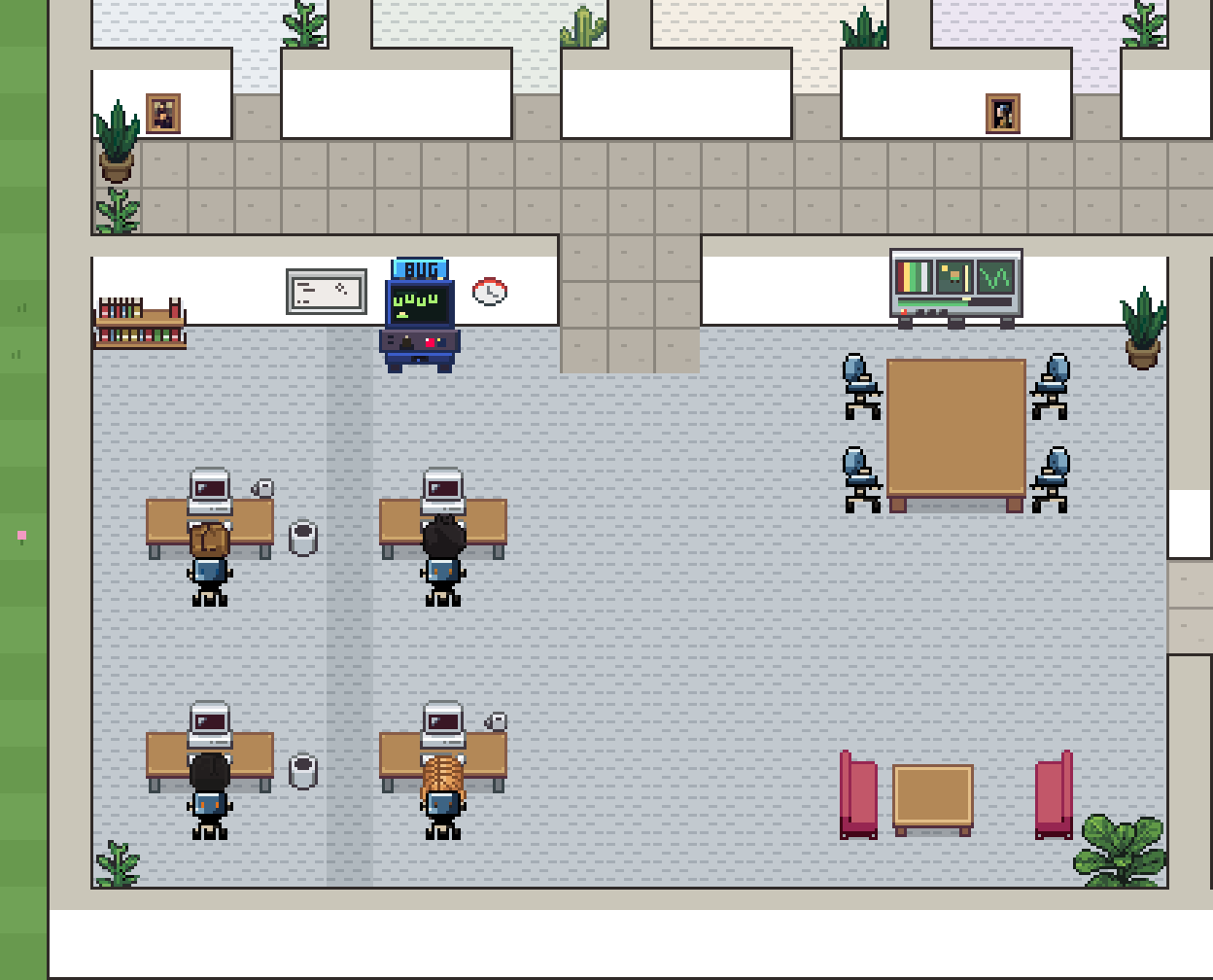
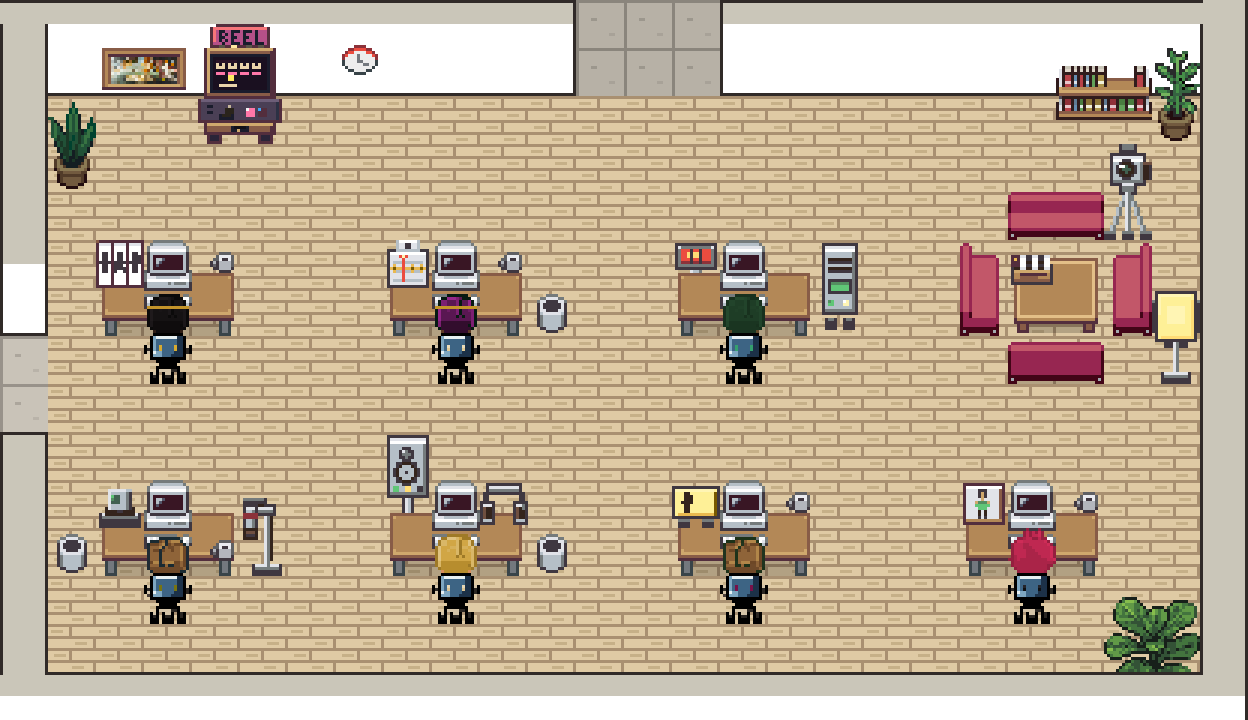
I can walk the office myself. If I walk up to an agent, it tells me what it's working on and what it has done so far. I can sit at my desk to message any of them, and check the rooms on CCTV. The same office also runs on a handheld game console, so I can check on the team from the sofa.
Guardrails instead of a review step
Work lands directly so nothing waits on me. The safety had to come from the system, not from my attention:
- A git hook refuses force-pushes, so history can be added to but never rewritten.
- Heavy builds queue for a shared lock, so the machine never runs two Android compiles at once.
- Agents that read untrusted web pages run sandboxed: they can search and read, but have no access to files, commands or connected accounts. A hidden instruction on a web page has nothing to act on. I tested it against a decoy secret file.
A team, not four tools
Agents are organised into squads with roles: backend, frontend, QA and DevOps. When a backend agent needs a screen, it doesn't attempt both sides. It asks the frontend agent, waits for the result, and finishes its own part. Specialist teams joined later: a studio for motion, audio, scripts and 3D, a hardware workshop for PCBs and CAD, and a media team.
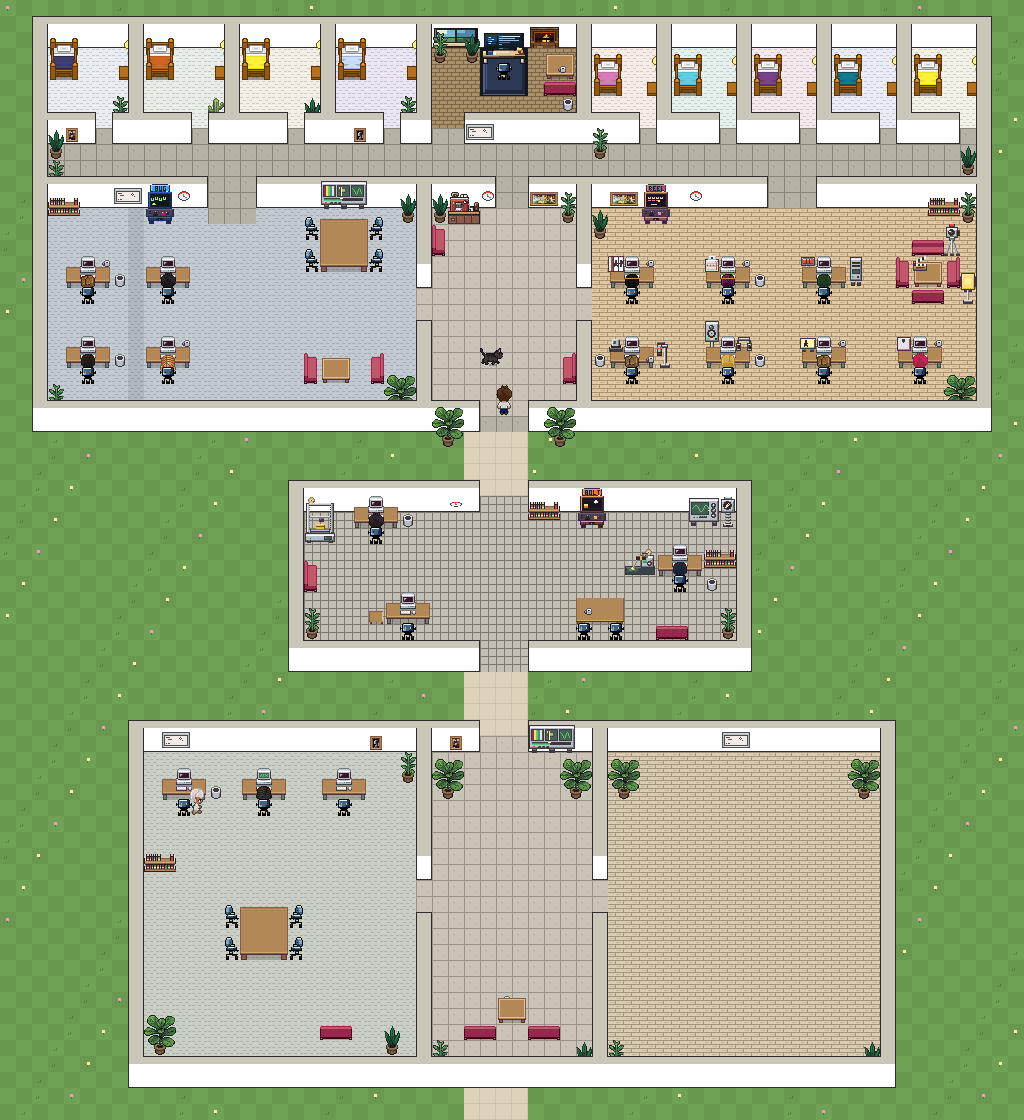
The office grew the way a real one does. When a new team arrived, it got its own building on the garden path.
What changed
- I spend my time deciding, not supervising. Most of what reaches me is a single question with good options.
- Work happens while I'm away. Tasks run through the day and night, and a scheduled routine starts work on its own.
- I can tell the state of 14 agents across 40 projects from one look at the office.
- 1,600+ tasks completed in the first six weeks.
What I'm working on next
- Showing an agent's reasoning next to its question, so I can approve faster and with more confidence
- A second machine that joins as an extra worker when there's a lot to do
- A social media team that drafts posts and waits for my approval before anything goes out